
Those are words which I recite often – they are from the Rite of Confirmation – that sacrament by which the individual Christian receives the Holy Spirit, sealing that gift of grace first outpoured in Baptism.
Dear Brothers and Sisters
“Be sealed with the gift of the Holy Spirit”
Those are words which I recite often – they are from the Rite of Confirmation – that sacrament by which the individual Christian receives the Holy Spirit, sealing that gift of grace first outpoured in Baptism.
This month we will celebrate the feast of Pentecost, which concludes the Easter season. The Lord Jesus Christ, who became incarnate for us; who died, rose and ascended into heavenly glory, that we too might share in his risen and eternal life, did not leave his followers as orphans but ascended with the promise of the Paraclete.
The Holy Spirit descended on those first disciples in tongues of fire; doors were burst open, the fear that constrained them evaporated and they went out into the city proclaiming the Good News of Jesus Christ. They were no longer scared individuals: they were the Church.
That Church, which received the Holy Spirit and began its apostolic witness on the day of Pentecost, remains today. The Catholic Church has born faithful witness for over 2000years and will do so until the end of time. She has endured trials and persecution, she has often been let down by her own members, but it is through that Church that men and women down the ages have come to experience the redeeming love of God and the good news of salvation. Saints have died rather than deny the truth as revealed to and taught by the Church. Each of us shares the beautiful grace of being called into that same Church, sealed by that same Spirit and sent out as missionary disciples.
As we rejoice in that glorious identity which we share with all Catholics, we do well to remember the opening words of the Apostolic Constitution “Anglicanorum Coetibus”:In recent times the Holy Spirit has moved Anglicans to petition repeatedly and insistently to be received into full Catholic communion individually as well as corporately.” The desire to enter into communion with the successor of Peter was, itself, the work of the Holy Spirit and it is from that same Holy Spirit that the life and mission of the Ordinariate flows.
The Ordinariate is that part of the Catholic Church to which we have been called and from which we participate in the mission inaugurated at Pentecost. The recent document on Patrimony from the Holy See makes this clear – the Ordinariate brings its own distinct patrimony as a treasure to be shared with the wider Church, as we receive from the whole Church the fullness of communion which enables us to fully engage in the transmission of the gospel.
Many of our communities are quite small, but they are vibrant. I am always encouraged in my visits and conversations to hear individual stories: a love for God because they have encountered, through his Church, His love for them. This Pentecost let us rejoice! Rejoice in God who has called us to his service, who has brought His Church into being, who has raised up the Ordinariate to be counted among His missionary disciples. Let us be open and brave!!
In Christ
+ David

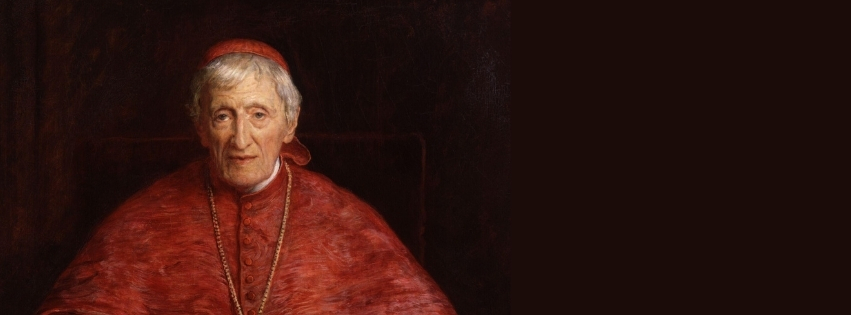
Albino Luciani, who became John Paul I, (and was later beatified), shared with St John Henry Newman’s inspiration, St Philip Neri, a very playful approach to preaching the Gospel. The Vatican, after the pope’s death, two months into his reign paid this moving and, in its phrasing, quite unique official tribute, by saying he was “…like a whirling comet…a flash of hope…a marvelous rainbow.”
The choice of such analogies would have intrigued Newman – as well as being applauded by him. One of his interests was astronomy, he built an observatory and always championed examples of using the gift of imagination in respect of religion.
Newman and John Paul I kept their gaze, like St Philip’s own, heavenward. But all three grounded their spirituality in humility and its linguistic connection to humour – which kept them earthed. The Oratorian watch-word is, after their founder, “love to be unknown”. Newman’s motto ‘heart speaks to heart’ embodies St Philip’s ideal. John Henry also had a great sense of fun too. While John Paul I chose as his papal motto “Humilitas”. He makes explicit the theological links between humour and humility in his first weekly catechetical address to the crowds gathered in Rome:
“When St Thomas Aquinas said Joking and making people smile was a virtue, he was in agreement with the “glad tiding” preached by Christ and the hilaritas recommended by St Augustine. He overcame pessimism, clothed Christian life in joy and invited us to keep up our courage also with healthy, pure joys, which we meet on our way.” (General Audience, 20th September 1978).
Newman, who with Aquinas is now the co-patron of education, is characterized by his friend Frederick Rogers, as seeming to have “…an intuitive perception of all that you thought and felt, so that he caught at once, all you meant or were driving at in a sentiment, a philosophical reflection, or a joke”. (Letters of Lord Blatchford, p14-15).
Newman shares in the same instinctive grasp of holiness and the inner joy that John Paul I experiences when he writes:
Let us pray to be filled with the spirit of love. Let us come to Church joyfully; let us partake the Holy Communion adoringly; let us pray sincerely; let us work cheerfully; let us suffer thankfully; let us throw our heart into all we think, say, and do; and may it be a spiritual heart! This is to be a new creature in Christ; this is to walk by faith. (Parochial and Plain Sermons V, 12).
Newman would also agree with John Paul I’s synthesis of what mission means when he says that the principal ecclesial “task of divinizing does not exempt the Church from the task of humanizing.” The coming of Christ as one like us in all things but sin, reveals that God understands us from the inside and communicates with us through our conscience. Newman taught that this encounter helps us identify right from wrong. Then, in freedom, he says, we can prudently choose, using practical wisdom, how to apply the Church’s teaching, revealed by the Holy Spirit, to particular situations. By educating our conscience, through prayer and the sacraments, the closer we will unite ourselves with God. And become, more speedily, the most humane person he calls us to be. As Newman, with the energy of Christ-centred zeal, states:
In all circumstances, of joy or sorrow, hope or fear, let us aim at having Him in our inmost heart. Let us acknowledge Him as enthroned within us at the very springs of thought and affection. Let us submit ourselves to His guidance and sovereign direction. Let us come to Him that He may forgive us, cleanse us, change us, guide us and save us. (Parochial and Plain Sermons V, 16).
Newman’s words direct us to look through the telescope of salvation and locate the constellations of faith, hope and love. We, as the Christmas-Magi and Easter morning star-gazers, are enthused by St John Henry Newman and John Paul I to become what we see.
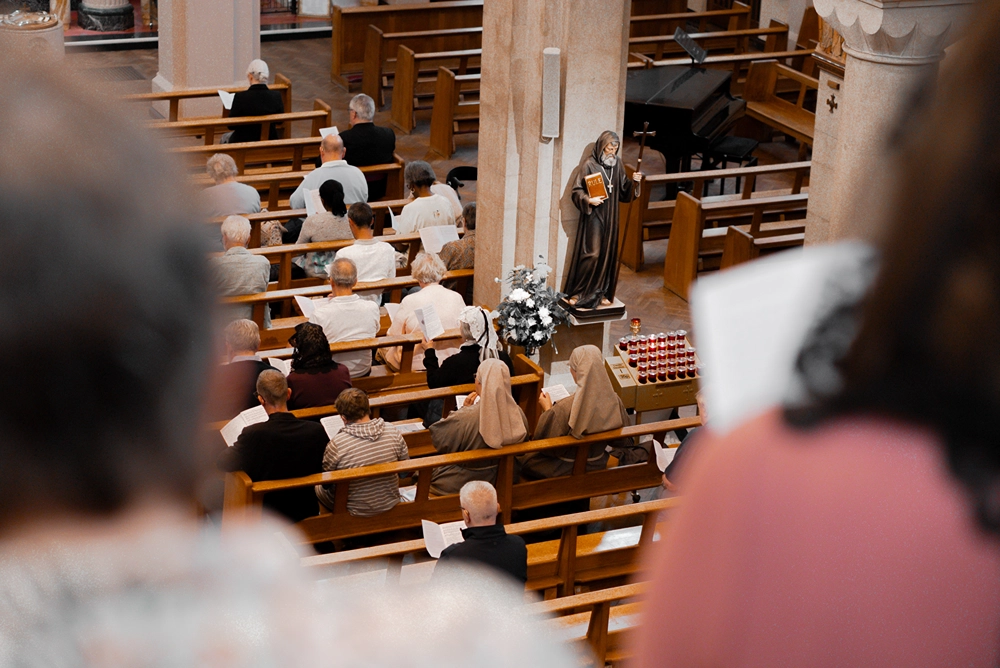
The recent document from the Dicastery for the Doctrine of the Faith has given the Church fresh language for something long known instinctively within the life of the Ordinariate: that the Anglican patrimony is “a precious gift […] and a treasure to be shared.” It speaks of beauty as evangelising, of a pastoral culture in which divine worship and daily life are intimately joined, and of a tradition that is not antiquarian but alive - received, lived, and handed on.
Nowhere is that more immediately apparent than in the realm of music and liturgy.
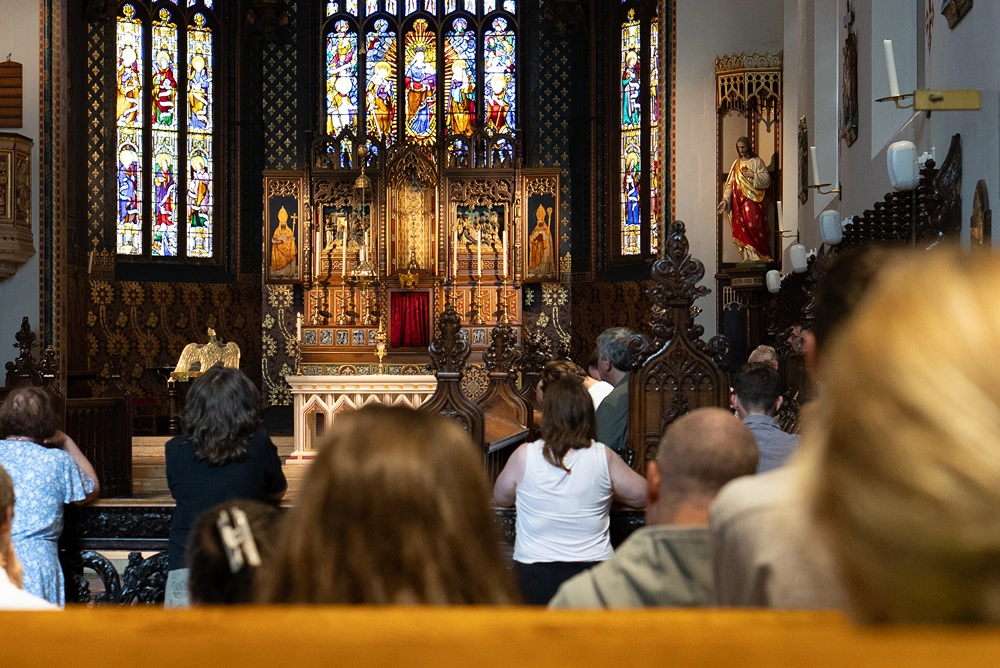
To encounter the Ordinariate at prayer is to encounter a tradition in which worship is not reduced to functionality, nor music treated as an accessory. Here, music belongs to the liturgy because it belongs to prayer. It is part of the offering. As Fr David Lashbrooke - Vicar General of the Personal Ordinariate of Our Lady of Walsingham - put it in our conversation on liturgy and music: “liturgy expresses our relationship with God.” And just as importantly: “it’s not a show.”
That distinction matters. In an age that instinctively turns almost everything into performance, the Ordinariate preserves a more demanding and more beautiful instinct: that sacred music exists not to entertain an audience, but to draw souls into the mystery of God. Fr David put it bluntly in speaking of carol services: “If someone leaves thinking they’ve been to a carol concert, we’ve manifestly failed.” The aim, rather, “is to draw people into the great mystery of the Incarnation.”
This is precisely the kind of insight the Roman document now helps illuminate. What the Ordinariate offers the wider Church is not merely a repertoire, nor a preferred aesthetic, but a whole sacramental imagination: a way of understanding that beauty can dispose the heart to truth, that music can carry doctrine, and that worship forms Christians not only by what is said, but by what is sung, repeated, remembered, and loved.
Fr David’s most suggestive point is that much of what people casually label “Anglican” in this context is, in fact, something older and deeper: part of the spiritual inheritance of these islands themselves. “It’s not a very Anglican thing. It’s a very English thing,” he said, speaking of traditions such as sung offices, carol services, and the scriptural, musical shaping of devotion. That is an important distinction. It places the Ordinariate’s liturgical life not simply in relation to the modern history of Anglicanism, but within the longer history of English Christianity: a history of plainsong and psalmody, of antiphons and processions, of cathedral foundations, parish choirs, mystery plays, vernacular devotion, and the enduring desire to let the faith be not only taught, but heard.
That wider cultural inheritance has been receiving renewed public attention. In January, The Telegraph described Evensong as “the very sound of English history,” arguing that choral worship still has a remarkable power to speak into a time of national uncertainty and cultural amnesia. At the same time, Cathedral Music Trust has been involved in a campaign to have “English Sacred Choral Music” recognised in the UK’s new inventory of intangible cultural heritage, describing it as a “living practice” with “a long, continuous history” from the medieval period to the present, expressed across denominations in liturgical worship as well as wider cultural life.
The Ordinariate stands in a particularly interesting relation to that conversation. It is not the sole guardian of this tradition, of course. But it is one of the places where it can still be seen whole: liturgy, music, scripture, doctrine, and devotion held together, not fragmented into concert culture on the one hand and utilitarian parish practice on the other. In the Ordinariate, the tradition is not admired from a distance. It is inhabited.
That is why hymnody matters so much. Fr David observed that “English spirituality” is often found most vividly “in our hymnody.” He is right. English sacred song has long done more than ornament devotion; it has taught the faith, lodged scripture in the memory, and cultivated reverence through poetry. George Herbert, metrical psalmody, ancient Latin hymns reborn in English dress, the great Victorian and Edwardian corpus, the carol tradition: all of these belong to a world in which doctrine was not merely explained, but sung until it became part of the inner life.
That instinct is missionary, not nostalgic. Fr David spoke movingly about the danger of allowing words like “English” to be emptied of spiritual meaning and claimed by narrower ideological projects. “We stop talking about spirituality,” he said. “We stop talking about English spirituality.” The Ordinariate’s musical and liturgical life quietly resists that impoverishment. It says that the faith of this land has a sound: reverent, scriptural, contemplative, incarnational. Not strident, not tribal, not self-enclosed, but ordered to the glory of God.
One sees this especially in the liturgical shape of Advent and Christmas, though the principle is evergreen. Fr David described the Advent carol service as a procession through scripture: from darkness to light, from prophecy to promise, from Isaiah to the Magnificat, ending not in cosy sentiment but in eschatological longing, even with Benediction and the great Advent cry of “Lo! he comes with clouds descending.” “It takes you from hope to realization,” he said.
This is not seasonal decoration. It is theology enacted through music, light, text, and silence.
And that, perhaps, is the heart of it. The Ordinariate’s liturgical music is not important merely because it is beautiful, though it often is. It is important because it embodies a way of receiving the faith. It assumes that people can be led gently and deeply into mystery; that scripture should be given its full resonance; that worship should take time; that beauty and truth belong together; that music offered “simply for the glory of God” changes those who offer it.
The Roman document has now named this reality with unusual clarity. The Anglican patrimony, lived in Catholic communion, is a gift to the Church’s mission today. In music and liturgy, that gift becomes audible. It is heard in the seriousness with which hymnody is chosen, in the conviction that liturgy is offering rather than performance, in the confidence that beauty still evangelises, and in the old but ever-new belief that what is sung with the lips may indeed be believed in the heart.

Lorem ipsum dolor sit amet, consectetur adipiscing elit, sed do eiusmod tempor incididunt ut labore et dolore magna aliqua. Ut enim ad minim veniam, quis nostrud exercitation ullamco laboris nisi ut aliquip ex ea commodo consequat. Duis aute irure dolor in reprehenderit in voluptate velit esse cillum dolore eu fugiat nulla pariatur.
Block quote
Ordered list
Unordered list
Bold text
Emphasis
Superscript
Subscript
Lorem ipsum dolor sit amet, consectetur adipiscing elit, sed do eiusmod tempor incididunt ut labore et dolore magna aliqua. Ut enim ad minim veniam, quis nostrud exercitation ullamco laboris nisi ut aliquip ex ea commodo consequat. Duis aute irure dolor in reprehenderit in voluptate velit esse cillum dolore eu fugiat nulla pariatur.
Block quote
Ordered list
Unordered list
Bold text
Emphasis
Superscript
Subscript
Lorem ipsum dolor sit amet, consectetur adipiscing elit, sed do eiusmod tempor incididunt ut labore et dolore magna aliqua. Ut enim ad minim veniam, quis nostrud exercitation ullamco laboris nisi ut aliquip ex ea commodo consequat. Duis aute irure dolor in reprehenderit in voluptate velit esse cillum dolore eu fugiat nulla pariatur.
Block quote
Ordered list
Unordered list
Bold text
Emphasis
Superscript
Subscript
Lorem ipsum dolor sit amet, consectetur adipiscing elit, sed do eiusmod tempor incididunt ut labore et dolore magna aliqua. Ut enim ad minim veniam, quis nostrud exercitation ullamco laboris nisi ut aliquip ex ea commodo consequat. Duis aute irure dolor in reprehenderit in voluptate velit esse cillum dolore eu fugiat nulla pariatur.
Block quote
Ordered list
Unordered list
Bold text
Emphasis
Superscript
Subscript
Lorem ipsum dolor sit amet, consectetur adipiscing elit, sed do eiusmod tempor incididunt ut labore et dolore magna aliqua. Ut enim ad minim veniam, quis nostrud exercitation ullamco laboris nisi ut aliquip ex ea commodo consequat. Duis aute irure dolor in reprehenderit in voluptate velit esse cillum dolore eu fugiat nulla pariatur.
Block quote
Ordered list
Unordered list
Bold text
Emphasis
Superscript
Subscript
Lorem ipsum dolor sit amet, consectetur adipiscing elit, sed do eiusmod tempor incididunt ut labore et dolore magna aliqua. Ut enim ad minim veniam, quis nostrud exercitation ullamco laboris nisi ut aliquip ex ea commodo consequat. Duis aute irure dolor in reprehenderit in voluptate velit esse cillum dolore eu fugiat nulla pariatur.
Block quote
Ordered list
Unordered list
Bold text
Emphasis
Superscript
Subscript
Lorem ipsum dolor sit amet, consectetur adipiscing elit, sed do eiusmod tempor incididunt ut labore et dolore magna aliqua. Ut enim ad minim veniam, quis nostrud exercitation ullamco laboris nisi ut aliquip ex ea commodo consequat. Duis aute irure dolor in reprehenderit in voluptate velit esse cillum dolore eu fugiat nulla pariatur.
Block quote
Ordered list
Unordered list
Bold text
Emphasis
Superscript
Subscript

